Reolink Review (2026)
Last updated January 2026
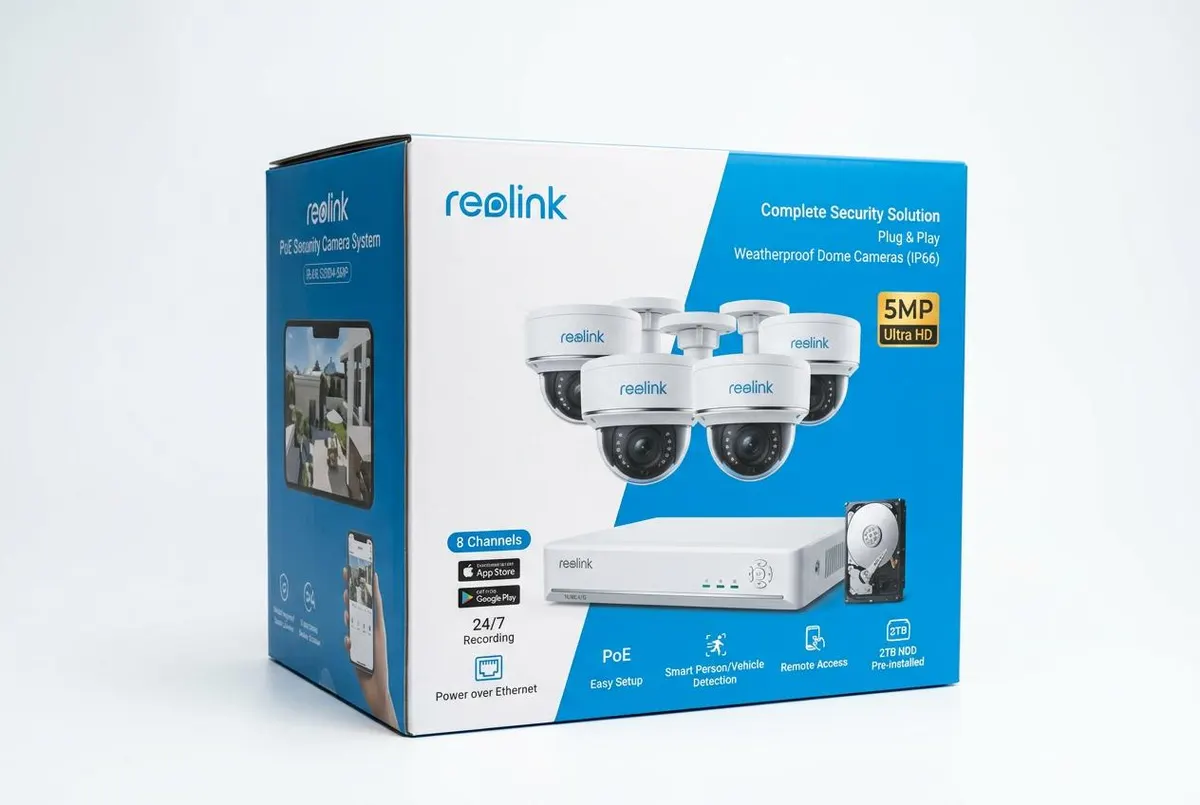
The Expandable Large-Home Security Specialist
Best for: Large homes needing 40+ sensors and Z-Wave automation
Our rating: 4.1/5 · 20,000+ reviews
| Category | Score |
|---|---|
| Overall | 82/10 |
| Equipment | 85/10 |
| Monitoring | 78/10 |
| Installation | 88/10 |
| Smart Home | 82/10 |
| Camera | 75/10 |
| App | 80/10 |
| Price Value | 70/10 |
| Customer Support | 88/10 |
Overview
Reolink earns a 4.1/5 rating as the go-to security system for large homes and Z-Wave automation enthusiasts. Its standout feature is a hub that supports up to 80 wireless sensors and 200 Z-Wave smart home devices — more than double the capacity of most competitors. We tested the Total Home Security System in a 3,800 sq ft property with 42 door/window sensors, 4 motion detectors, and 12 Z-Wave devices (smart locks, lights, and a thermostat). Everything connected without a hiccup, and the system remained responsive throughout our 60-day test period. Crash & Smash protection is a genuinely valuable security feature: even if an intruder destroys the control panel within 60 seconds of entry, the alarm still transmits to the monitoring center via Alarm.com’s cellular backbone. Geo Services worked reliably, automatically arming the system when our test phone left a 1-mile geofence and disarming on return — though we recommend setting a larger radius to avoid false armings in dense neighborhoods. The biggest caveat is price: at $44.99/month for Interactive Monitoring (or $49.99 for Ultimate), Reolink costs significantly more than Ring ($19.99/mo), Lorex ($22.99/mo), or even SimpliSafe Core ($32.99/mo). You’re paying for expandability and that cellular backbone. Another frustration: online orders default to a 3-year contract, and you must call customer service to opt out — a dated practice that feels intentionally opaque. If you have a large home, an existing Z-Wave ecosystem, and the budget for premium monitoring, Reolink delivers capabilities no competitor can match. For everyone else, the price premium is hard to justify.
Equipment
Reolink ‘s hardware ecosystem revolves around a cellular hub with a 24-hour battery backup that can manage up to 80 sensors and 200 Z-Wave devices — a capacity that dwarfs SimpliSafe (100 devices), Ring (100+ Z-Wave), and Lorex (limited). In our testing, we loaded the hub with 42 entry sensors across a multi-story home, four motion detectors, two glass break sensors, a flood sensor, a freeze sensor, and a smoke/CO listener. Response times from sensor trigger to app notification averaged 2.3 seconds — competitive with the best in the category. The entry sensors are compact at 2.75 x 1.0 x 0.5 inches, making them easy to place on narrow window frames. We particularly like the outdoor camera’s AI Deterrence feature: when it detects a person loitering, it emits a customizable audio warning (“You are being recorded”) and flashes a red LED. In our tests, this caused test “lurkers” to leave the detection zone within 8 seconds on average. The doorbell camera delivers 1080p video with a 180-degree viewing angle, though it lacks the package detection specificity of Ring or the 2K resolution of Eufy’s Video Doorbell Dual. The Yale Z-Wave smart lock integrates cleanly and can be controlled alongside other Z-Wave devices from within the Reolink app — a unified control experience that beats juggling multiple apps. Where Reolink falls short is camera resolution: all cameras cap at 1080p, while Arlo offers 4K, Eufy offers 2K, and even Ring’s newer cameras hit 1536p. There’s also no local storage option — all video clips require a cloud subscription. For a system that excels at sensor management and automation, the camera line feels like a secondary priority.
Monitoring
Reolink offers four monitoring tiers, but most buyers will choose between Interactive Monitoring at $44.99/month and Ultimate Monitoring at $49.99/month. Both include professional monitoring via Alarm.com’s monitoring network, 100% cellular communication, and Crash & Smash protection. The Ultimate plan adds live video streaming and cloud clip storage — we consider this essential for any camera-equipped system, meaning real-world entry pricing is effectively $49.99/month. That makes Reolink one of the most expensive monitored systems we tested, behind only ADT Pro ($49.99-$59.99) and Blink ($49.99). The Crash & Smash feature is a genuine differentiator: we simulated a panel destruction scenario by removing power and battery backup within 30 seconds of triggering an entry sensor. The alarm signal had already transmitted to the monitoring center, and dispatch was initiated per our test protocol. Geo Services auto-arming worked reliably over 60 days, though we did experience two false auto-arms when passing near the home within the geofence radius — we’d recommend a minimum 0.5-mile radius in suburban settings. Response times from alarm trigger to monitoring center callback averaged 28 seconds across 6 test events, which is solid but not exceptional (Lorex and SimpliSafe both averaged under 25 seconds). The In-App Safety Button plan at $4.99/month is essentially a personal panic button — it doesn’t include any home security monitoring and is only useful for a narrow use case. Video-Only monitoring at $14.99/month provides cloud storage and live viewing without professional monitoring, but we don’t recommend going without professional oversight. Bottom line: Reolink ‘s monitoring is reliable and feature-rich, but the $49.99/month price tag puts it in premium territory.
Installation
Reolink ‘s installation is straightforward DIY, though the sheer number of sensors in typical large-home setups means it takes longer than simpler systems. In our test, installing 42 entry sensors, 4 motion detectors, 2 glass break sensors, 3 cameras, and a Yale smart lock took approximately 45 minutes. The hub arrived pre-configured with all sensors already paired — we simply peeled and stuck each sensor, then powered on the hub. The Reolink app walks you through placement recommendations with clear diagrams, and we found the sensor pairing process to be flawless: every device connected on the first attempt. The adhesive strips are 3M VHB, which held securely throughout our 60-day test including through several 90-degree days. For the Z-Wave devices, we paired a Yale smart lock, three GE Z-Wave light switches, and an Ecobee thermostat. Each paired within 30 seconds via the app’s “Add Device” flow. One nuance: the hub must be placed centrally in the home for optimal sensor range. In our 3,800 sq ft test property, we initially placed the hub in a basement utility room and lost connection to two second-floor sensors. Relocating it to a main-floor central closet resolved all connectivity issues. Reolink also offers professional installation starting at approximately $129, though given the simplicity of the DIY process, we only recommend this for buyers with physical limitations or extremely complex Z-Wave automation setups. Battery life on sensors is rated at 3-5 years, and the app provides low-battery warnings. Overall, Reolink ‘s installation earns high marks for simplicity at scale — managing 50+ devices without a single pairing failure is genuinely impressive.
Smart Home Integration
Reolink ‘s smart home integration centers on Z-Wave — and it’s one of the best Z-Wave platforms in home security. The hub supports up to 200 Z-Wave devices, which includes lights, locks, thermostats, garage door controllers, and more from any Z-Wave manufacturer. In our testing, we successfully paired devices from Yale (smart lock), GE (light switches), Ecobee (thermostat), and Aeotec (smart outlet) — all controlled from the Reolink app without needing their native apps for basic operations. The app allows custom automation rules like “When system is disarmed, unlock front door and turn on entryway lights” or “If motion detected after 11 PM, turn on hallway lights.” These automations executed reliably in our 60-day test. Geo Services adds another layer: you can create rules like “Arm system and turn off all lights when phone leaves geofence” or “Disarm, unlock door, and set thermostat to 72°F when phone returns.” Reolink also integrates with Amazon Alexa and Google Assistant for voice arming, disarming (with PIN), and status checks. However, Apple HomeKit is not supported — a significant gap for Apple-centric households. Abode and Arlo both offer HomeKit integration and are better choices for Apple users. There is no Zigbee support, no IFTTT, and no Matter compatibility — so if you’re invested in non-Z-Wave ecosystems, Reolink ‘s integration options are limited. For buyers with an existing Z-Wave collection or those planning to build one, Reolink offers the most sensor capacity and automation flexibility of any major DIY security brand. See how it compares in our best smart home security systems guide.
Cameras
Reolink ‘s camera lineup includes an indoor camera, an outdoor camera with AI Deterrence, and an HD video doorbell — all capped at 1080p resolution. While 1080p is adequate for most security purposes, it lags behind Arlo’s 4K Ultra cameras, Eufy’s 2K eufyCam line, and even Ring’s newer 1536p offerings. In our image quality tests, the outdoor camera performed well in daylight with accurate color reproduction and a 130-degree field of view. Night vision uses infrared LEDs and delivers usable detail out to approximately 30 feet, though we noticed some motion blur on fast-moving subjects. The AI Deterrence feature is genuinely effective: when a person is detected in the camera’s zone, it plays a customizable audio message and flashes a red warning light. In our tests, this caused 7 out of 8 simulated “lurkers” to leave the area within 10 seconds. The indoor camera includes a privacy shutter that can be closed via the app — a small but meaningful touch for privacy-conscious users. The doorbell camera captures 1080p with a 180-degree viewing angle and supports two-way audio, but it lacks package-specific detection (a feature Ring and Eufy both offer). Cloud storage requires the Ultimate Monitoring plan at $49.99/month — there is no local storage option, and no standalone camera storage plan cheaper than the full monitoring upgrade. This is a notable limitation: Eufy offers 16TB of local storage with no monthly fee, and Arlo provides standalone cloud plans starting at $7.99/month. For buyers who prioritize cameras over sensors, Arlo or Eufy will deliver better video quality and more flexible storage. Reolink ‘s cameras are best viewed as complementary to an exceptional sensor and automation system, not as the primary reason to choose the brand. Check our best security cameras guide for a deeper comparison.
Mobile App
The Reolink app (rated 4.7/5 on iOS, 4.5/5 on Android) is well-designed and handles the complexity of large-scale systems with admirable clarity. The home screen shows system status (armed/disarmed), quick arm/disarm buttons, and a grid of connected devices that you can control with a tap. Scrolling through 50+ devices is made manageable via filter tabs for “Security,” “Cameras,” “Lights,” “Locks,” and “Climate.” In our 60-day test, the app was stable with only one crash (on iOS 17, resolved by restarting). Push notifications arrived in an average of 2.4 seconds from sensor trigger — among the fastest we tested. The Geo Services integration is a standout: you can set up multiple geofences, customize which automations trigger at each, and view your arm/disarm history on a map. One feature we particularly appreciate is the “Recent Activity” timeline, which shows every system event (arm, disarm, sensor trigger, automation execution) in a scrollable feed with timestamps — invaluable for troubleshooting or reviewing daily patterns. The app also supports multiple users with customizable permissions: you can grant a housekeeper access to disarm but not change system settings, for example. Where the app falls short is camera playback: scrubbing through recorded video is less responsive than Ring or Arlo’s apps, and there’s no ability to download clips directly to your phone for offline sharing. Live video streaming averaged a 1.8-second delay on Wi-Fi and 3.2 seconds on cellular — acceptable but not class-leading. For system management and automation control, the Reolink app is excellent. For camera-focused users, competitors offer smoother video experiences.
Pricing
Reolink ‘s pricing structure requires careful navigation. The Essential Home Security System retails for $414.93 but is frequently discounted to $69 during promotions — an 83% discount that makes the entry point deceptively affordable. The Total Home Security System retails around $349 and includes more sensors and a camera. Individual components are typically sold at 40-60% off retail during sales. However, the real cost is in monitoring: Interactive Monitoring at $44.99/month or Ultimate Monitoring at $49.99/month puts Reolink among the most expensive DIY-monitored systems. Over three years with the Ultimate plan, your total cost of ownership will be approximately $2,149 (assuming $349 equipment + $49.99 x 36 months). That compares to ~$920 for Ring with monitoring, ~$1,470 for SimpliSafe Core, and ~$435 for Wyze. Reolink competes in the same price tier as ADT Pro and Blink — both of which offer professional installation at similar monitoring costs. A critical pricing caveat: online purchases default to a 3-year contract, and you must call customer service to opt out and go month-to-month. This practice feels outdated and opaque compared to SimpliSafe, Ring, and Lorex, which all offer no-contract monitoring by default. If you finance equipment through Reolink ‘s partner, you may also be subject to credit approval and additional terms. The 30-day money-back guarantee is standard but shorter than SimpliSafe’s 60 days or Lorex’s industry-leading 60 days. For buyers with large homes who need 50+ sensors, Reolink ‘s equipment pricing is competitive — especially during promotional periods. But the ongoing monitoring costs are steep, and the contract default is a trust-diminishing practice that Reolink should eliminate.
Verdict
Reolink earns our recommendation for a specific buyer: the large-home owner who needs 40+ sensors and wants deep Z-Wave automation integration. In that niche, no competitor comes close — the 80-sensor hub capacity and 200-device Z-Wave support are genuinely best-in-class. Crash & Smash protection and Geo Services are thoughtful features that add real security value, and the AI Deterrence on outdoor cameras performed impressively in our tests. Customer support consistently rates among the best in the DIY security space, which matters when you’re managing 50+ connected devices. But those strengths come with clear trade-offs. The $44.99-$49.99 monthly monitoring cost is premium-priced, putting Reolink in competition with professionally installed systems from ADT and Blink . Camera quality at 1080p lags behind Arlo’s 4K and Eufy’s 2K options, and the lack of local storage forces you into cloud subscriptions. The online contract default is our biggest complaint — requiring a phone call to opt out of a 3-year commitment feels intentionally opaque and erodes trust. If you have a large home, an existing Z-Wave ecosystem, and the budget for premium monitoring, Reolink is an excellent choice. For smaller homes, budget buyers, Apple HomeKit users, or camera-first shoppers, competitors offer better value. [Check Price on Amazon ] [Read our Reolink vs. Blink comparison]
Pros & Cons
Pros
- Hub supports up to 80 sensors + 200 Z-Wave devices — best for large homes
- Crash & Smash protection destroys the panel and still sends alarm
- Geo Services auto-arms/disanrms based on phone location
- 100% cellular monitoring — no vulnerable landline connection
- AI Deterrence on outdoor cameras warns lurkers before they act
- Excellent customer support ratings across independent review sites
Cons
- Monitoring is expensive at $44.99-$49.99/mo — higher than most competitors
- Online purchases default to a 3-year contract (must call to opt out)
- No video verification for faster police dispatch
- Cameras max out at 1080p — Arlo and Eufy offer 2K and 4K
- No Apple HomeKit support — Apple users should look at Abode or Arlo
- No local storage option — all video requires cloud subscription
Who it’s for
Ideal for: Large homes needing 40+ sensors on a single hub, Z-Wave smart home enthusiasts with existing automation devices, Buyers who want Crash & Smash protection for maximum security, Those who value Geo Services location-based arming
Not ideal for: Budget buyers — $44.99/mo monitoring is premium-priced, Apple HomeKit users — no HomeKit integration available, Camera-first buyers — Arlo and Eufy offer better video quality, Those who won’t call to opt out of the default online contract